
Customer Success Story
How a Major North American Tier 1 Automotive Supplier Connected Design to Execution with High QA and PolyWorks
For one major North American Tier 1 automotive supplier, the push toward a corporate-wide Model-Based Enterprise strategy created a clear mandate: quality processes had to evolve. Across multiple plants, the company needed a more connected, scalable way to move from design requirements to inspection execution without the delays, rework, and risk that came with traditional workflows.
By integrating High QA Inspection Manager with PolyWorks | Inspector, the supplier established a digital thread from design to execution and turned a fragmented process into a more efficient, standardized quality workflow.
The Challenge: Too Much Manual Effort, Not Enough Continuity
Like many large manufacturers, the supplier’s quality teams were operating in an environment shaped by legacy process habits. Manual ballooning of 2D drawings and 3D models consumed hundreds of hours. Design requirements were not automatically connected to metrology software, which meant critical data had to be re-entered into PolyWorks by hand. Standardizing inspection plans across facilities was difficult, revision control was a constant concern, and manually transferring tolerances into CMM programs introduced unnecessary risk for human error.
The issue was not simply inefficiency at one point in the workflow. It was the compounding effect of disconnected systems across the broader quality process. Every manual touch introduced more time, more variation, and more opportunity for something to be lost between design and execution.
The Turning Point: Modernizing the Quality Workflow
To close that gap, the supplier implemented High QA Inspection Manager together with the High QA connector for PolyWorks. The objective was straightforward: create a more seamless connection between CAD, inspection planning, and metrology execution while reducing non-value-added work.
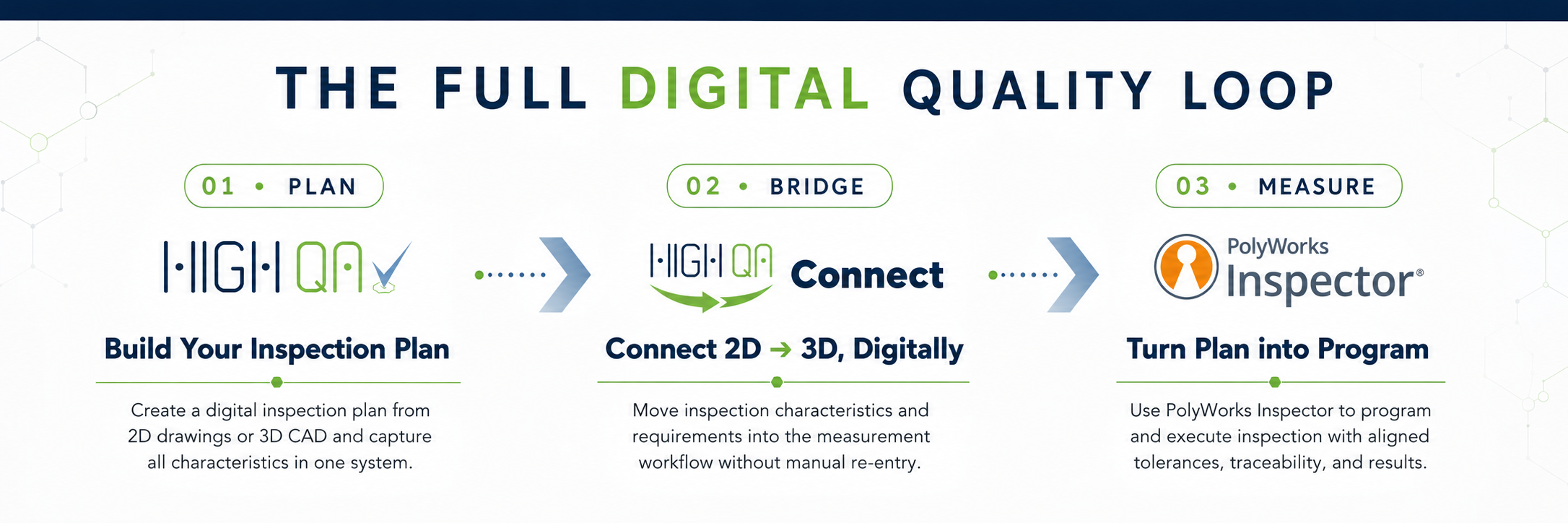
High QA’s role in that process was foundational. Dimensions and tolerances could be extracted automatically from 2D and 3D files to create a digital Bill of Characteristics. Those inspection requirements could then be pushed directly into PolyWorks Inspector, eliminating manual programming steps and synchronizing nominal values and tolerances. A centralized database for drawings and results gave the organization stronger revision control and traceability across all sites.
What had previously been a manual chain of disconnected steps became a more unified digital quality workflow.
A Structured Rollout Built for Scale
The supplier approached implementation with the discipline expected of a large, multisite manufacturer. The rollout was executed in three phases to validate the solution technically, quantify business value, and support long-term adoption.
The first phase focused on pilot validation. Over a three-month proof of concept, the company tested both auto-ballooning efficiency and the PolyWorks integration workflow.
Floating licenses were deployed, and intensive training was delivered through the High QA Academy across two pilot facilities.
The second phase centered on ROI validation. The supplier conducted time studies comparing manual PolyWorks programming against the new connector-driven workflow, building the enterprise case for broader rollout.
The third phase expanded the deployment across multiple North American plants using a centralized server approach. That phase emphasized plant-level data segregation strategies and the development of internal champions who could help scale adoption inside the organization.
The Impact: Less Manual Work, Faster Programming, Clear ROI
The results were substantial. By automating ballooning and CMM programming workflows, the supplier significantly reduced non-value-added labor and improved throughput across complex parts. The company reported approximately 800 hours saved per year per license, with throughput of roughly 80 to 90 complex parts per year per license.
From a financial standpoint, the business case was equally clear. Using the labor rate of a senior quality engineer, the supplier calculated up to $55,000 in annual savings per license, based on an approximate rate of $60 per hour.
The internal view of value was direct:
“Auto-ballooning alone provided enough ROI to justify the investment, but the PolyWorks integration became our primary productivity driver.”
The Takeaway: The Functional Digital Thread
This initiative did more than accelerate inspection planning. It created a functional digital thread connecting design to metrology execution. By eliminating manual data transfer and standardizing how requirements moved through the workflow, the supplier improved consistency, reduced programming time, lowered risk, and created a stronger foundation for long-term competitiveness.
For manufacturers working to modernize quality in support of broader MBE goals, the lesson is clear: when design data, inspection planning, and execution are connected in one digital process, the payoff is not only efficiency — it is greater control, stronger scalability, and measurable financial return.
About High QA
High QA is a manufacturing quality platform that connects design requirements to execution. We make the 2D drawing or 3D model the single source of truth by automatically extracting quality requirements and linking them directly to inspection planning, inspection execution,
NCRs, and quality reporting. This reduces manual interpretation and re-entry across teams and systems, improves traceability, and helps ensure parts are built and verified to spec.
